CAR SHAKES WHEN ACCELERATING – COMMON CAUSES, RISKS AND WHAT TO CHECK
Complete guide to a car that shakes when accelerating: most common causes, warning signs, when to stop driving, and practical checks before repairs.

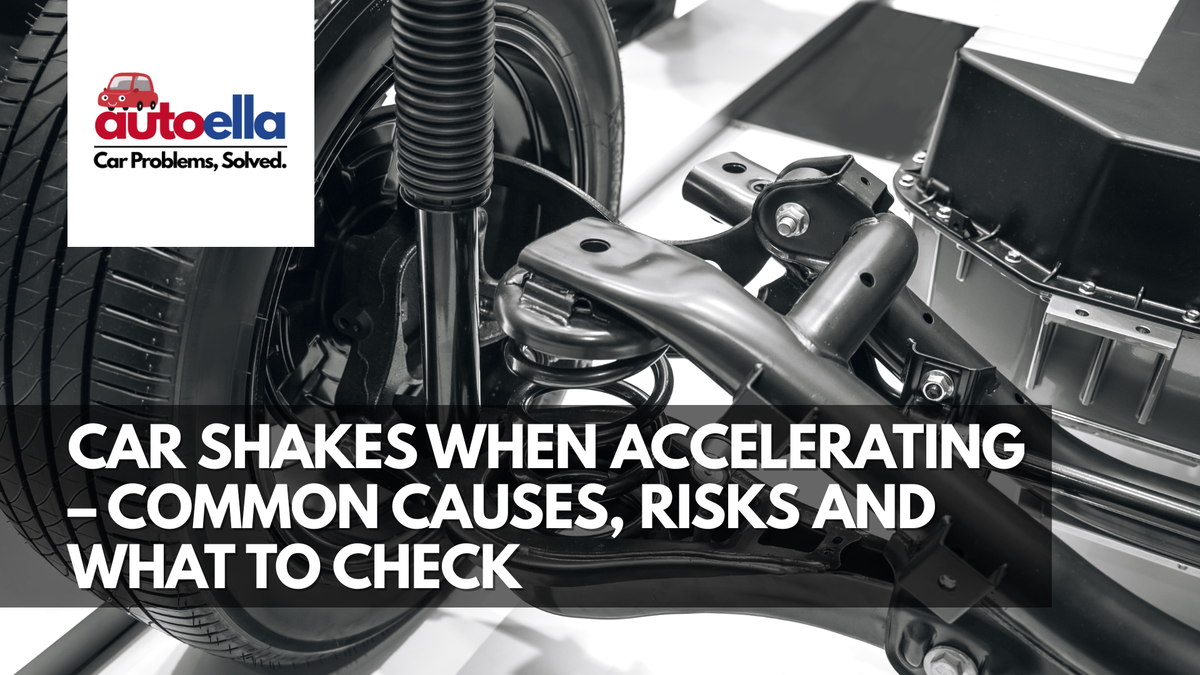
CAR SHAKES WHEN ACCELERATING – COMMON CAUSES, RISKS AND WHAT TO CHECK
A car that shakes when accelerating is one of the most common “something feels wrong” complaints in real workshops. Sometimes it’s a simple tire or wheel issue, but many cases come from the drivetrain: worn CV joints, a failing engine mount, a misfire under load, or a transmission/axle problem starting to show itself. In this guide we organize, in a clear and practical way, the most common causes, the risks of continuing to drive, and a technician-style checklist of what to check first so you don’t waste money replacing the wrong parts.
The key is to narrow the symptom down: does the vibration happen only under acceleration, only at certain speeds, only while turning, or also while braking? Those details usually point directly to the right system.
📋 WHAT YOU'LL FIND IN THIS GUIDE
- ✅ What “shakes when accelerating” usually means
- 🧠 The symptom patterns that narrow it down fast
- 🛞 Tires/wheels: imbalance, damage and uneven wear
- 🦾 CV axles and joints: classic vibration under load
- 🔩 Engine and transmission mounts: movement you can feel
- ⚡ Misfire under load: shakes that feel like vibration
- ⚙️ Transmission/drivetrain issues: when to be careful
- ⛔ When you should stop driving
- 🧭 Practical checks before you spend money
- 🏁 Conclusions and next steps
✅ WHAT “CAR SHAKES WHEN ACCELERATING” USUALLY MEANS
In most cases, shaking during acceleration is caused by something that is loaded when you press the throttle: the engine produces torque, the drivetrain transfers it to the wheels, and any looseness, imbalance or misfire becomes obvious.
The most common buckets are:
- Tire/wheel issues (imbalance, bent rim, separated tire, uneven wear).
- CV axle / joint wear (especially front-wheel-drive and many AWD cars).
- Engine/transmission mounts allowing excessive movement under load.
- Misfire under load (ignition/fuel/air issues that show up only when accelerating).
- Drivetrain or transmission problems (less common, but important to catch early).
🧠 THE SYMPTOM PATTERNS THAT NARROW IT DOWN FAST
Before replacing parts, answer these questions. They’re exactly what a good technician will ask:
1) Does it happen at a specific speed range?
- Mostly 50–70 mph: often wheel balance/tire issues.
- Only when accelerating through a range: often CV axle or mount-related.
2) Does it change when you lift off the throttle?
- Shakes under throttle, smooth on coast: classic drivetrain/CV/mount pattern.
- Shakes even when coasting: more likely wheel/tire or bearing-related.
3) Does it get worse when turning?
- Worse on turns under acceleration: often outer CV joint wear.
4) Do you feel it in the steering wheel or the seat?
- Steering wheel: often front tires/wheels, front drivetrain, front suspension.
- Seat/floor: often rear tires/wheels, rear drivetrain, driveshaft (RWD/AWD).
🛞 TIRES/WHEELS: IMBALANCE, DAMAGE AND UNEVEN WEAR
Tires and wheels are the simplest place to start because they can create vibrations that feel exactly like a drivetrain issue. Many people replace parts unnecessarily when the real cause is a damaged tire or bent rim.
Common causes
- Wheel imbalance (weights missing, uneven tire wear).
- Bent wheel from potholes or curb impact.
- Tire separation (internal belt issue) that creates a “wobble” under load.
- Uneven wear from alignment or suspension problems.
What to check
- Inspect tire sidewalls for bulges, bubbles, or cracks.
- Look for scalloping/cupping (often suspension/shock related).
- Check for missing wheel weights and get a proper balance if unsure.
🦾 CV AXLES AND JOINTS: CLASSIC VIBRATION UNDER LOAD
A worn CV axle is one of the most common real workshop causes of “shakes when accelerating” on FWD and many AWD cars. It often feels like a deep vibration that increases with throttle input.
Typical signs
- Vibration that gets stronger with acceleration and reduces when you coast.
- Clicking noise while turning (outer CV joint) in many cases.
- Grease splatter around the wheel well from a torn CV boot.
Workshop approach
- Check CV boots for tears and grease leaks.
- Check axle play and joint movement with the car safely lifted.
- On some cars, a slightly bent axle or internal joint wear causes vibration without obvious noise.
🔩 ENGINE AND TRANSMISSION MOUNTS: MOVEMENT YOU CAN FEEL
Worn mounts allow the engine/transmission to shift too much when torque is applied. That movement can transmit vibration into the cabin and may also stress exhaust joints and driveline components.
Common signs
- Thump or clunk when shifting from Park to Drive/Reverse.
- Vibration increases when accelerating, especially at low speed.
- Visible engine movement when revving in Park/Neutral (within reason).
What to check
- Look for collapsed rubber, cracks, or leaking hydraulic mounts (some designs).
- Pay attention to harshness that feels “engine-related” rather than wheel speed-related.
⚡ MISFIRE UNDER LOAD: SHAKES THAT FEEL LIKE VIBRATION
Not every “shake” is a physical vibration. A misfire under load can feel like the car is vibrating or shuddering, especially on turbo or direct-injection engines when you ask for power.
Common causes
- Worn spark plugs (gap too large), weak coils, ignition tracking.
- Fuel delivery issues (low fuel pressure, clogged injectors).
- Boost leaks or intake leaks (turbo engines).
What to check first
- Scan for codes, including pending codes.
- Check misfire counters and fuel trims with live data.
- If the shake is paired with a flashing check engine light, treat it as urgent.
⚙️ TRANSMISSION/DRIVETRAIN ISSUES: WHEN TO BE CAREFUL
Less commonly, the vibration comes from deeper drivetrain problems: torque converter shudder, driveshaft issues (RWD/AWD), differential wear, or wheel bearing problems. These usually have other clues.
Clues that point deeper
- Shudder at a steady speed with light throttle (sometimes torque converter-related).
- Vibration that increases with speed regardless of engine load (sometimes driveshaft/bearing).
- New whining or humming noises that change with speed.
⛔ WHEN YOU SHOULD STOP DRIVING
You can often drive carefully to a workshop for diagnosis, but you should stop driving (or avoid highway speeds) if you notice any of these:
- Severe shaking that suddenly gets worse.
- Burning smell, smoke, or a strong fuel smell.
- Flashing check engine light, loss of power, or loud knocking.
- Clunking noises that suggest a failing CV joint or driveline component.
A failed drivetrain component at speed can cause loss of control or secondary damage. If it feels unsafe, it probably is.
🧭 PRACTICAL CHECKS BEFORE YOU SPEND MONEY
Here’s a technician-style order of operations that prevents wasted repairs:
Step 1: Identify the pattern
- Only under acceleration vs also while coasting.
- Speed-specific vs throttle-specific.
- Steering wheel vs seat/floor vibration.
Step 2: Quick tire/wheel inspection
- Bulges, uneven wear, missing weights, bent rims.
- If unsure, do a proper balance and inspection first.
Step 3: Check CV boots and axle area
- Grease leaks, torn boots, clicking on turns, visible play.
Step 4: Scan for misfires and fuel trim issues
- Even without a check engine light, pending codes and misfire data can reveal the cause.
Step 5: Mount inspection
- Look for collapsed mounts, excess movement, harsh clunks on gear changes.
🏁 CONCLUSIONS AND NEXT STEPS
A car that shakes when accelerating usually points to a component that is stressed under load: tires/wheels, CV axles, mounts, or an engine misfire that appears when you ask for power.
The most important takeaway is to diagnose based on the symptom pattern — not on guesswork. Start with the simple checks (tires and wheels), then move to axles and mounts, and use an OBD scan to rule out misfire-related causes.
If the shaking is severe, sudden, or paired with warning lights, avoid hard driving and get the car checked promptly. Catching the real cause early is almost always cheaper than dealing with secondary damage later.