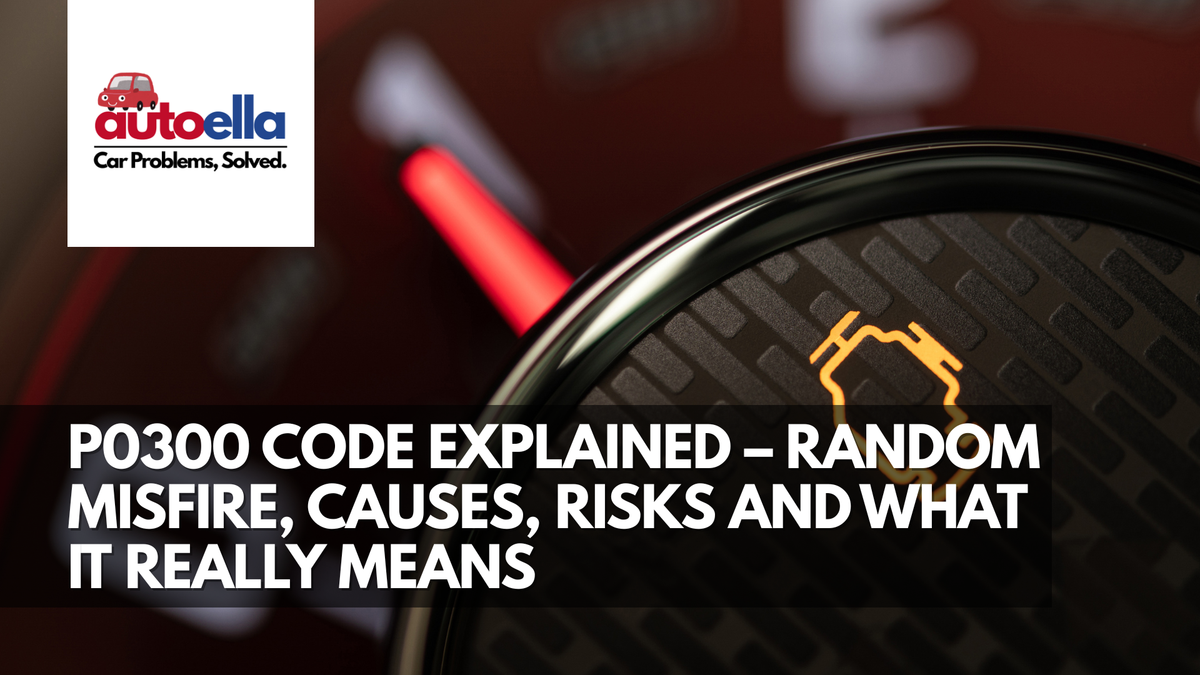
P0300 CODE EXPLAINED – RANDOM MISFIRE, CAUSES, RISKS AND WHAT IT REALLY MEANS
Understand P0300 random misfire, what it means, common causes, real risks, and what to do next without guessing.

P0300 CODE EXPLAINED – RANDOM MISFIRE, CAUSES, RISKS AND WHAT IT REALLY MEANS
Seeing P0300 on an OBD2 scanner can be confusing because it sounds specific, but it doesn’t point to a single part. P0300 means the engine computer detected a random or multiple-cylinder misfire — in other words, the misfire is not consistently tied to one cylinder. That can happen for several reasons, from ignition or fuel delivery weaknesses to air mixture issues that affect the whole engine. In this guide, we’ll explain what P0300 really means, what it does and does not tell you, the real risks of continuing to drive, and how to make informed next-step decisions without guesswork.
📋 WHAT YOU'LL FIND IN THIS GUIDE
- 🔧 What P0300 means (in plain English)
- 🧠 Why it says “random/multiple” instead of one cylinder
- ✅ What P0300 can tell you
- ❌ What P0300 cannot tell you
- 📌 Common causes (patterns, not parts)
- ⚠️ Real risks: when to be cautious
- 🧭 What to do next (decision logic)
- 🔗 How this connects to other Autoella guides
- ❓ Quick FAQ
🔧 WHAT P0300 MEANS (IN PLAIN ENGLISH)
P0300 is a generic OBD2 code that means the engine computer detected a misfire pattern that is random or affecting multiple cylinders.
A misfire is not “a noise.” It’s an event where a cylinder does not contribute normal power. The car’s computer detects this by monitoring subtle changes in crankshaft speed and engine behavior. When the misfire is consistently linked to one cylinder, you may see codes like P0301, P0302, and so on. With P0300, the computer is essentially saying: “I’m detecting misfires, but they’re not consistently tied to one specific cylinder.”
🧠 WHY IT SAYS “RANDOM/MULTIPLE” INSTEAD OF ONE CYLINDER
P0300 often appears when the underlying problem affects the engine more broadly, or when the misfires move around. In real-world terms, that usually points to conditions that can influence more than one cylinder at once.
Common reasons the misfire does not “stay” on one cylinder
- The issue affects the overall mixture (air and fuel) rather than one cylinder.
- The problem is intermittent and appears only under certain loads, temperatures, or speeds.
- The engine is close to the threshold, so small changes in driving conditions cause misfires to show up in different cylinders.
This is why P0300 can feel frustrating: it’s real, but it’s not a direct “replace this part” instruction.
✅ WHAT P0300 CAN TELL YOU
- The engine is not firing smoothly, at least in some operating conditions.
- The misfire is not consistently isolated to a single cylinder.
- How urgent it may be depends on symptoms and whether the Check Engine Light is steady or flashing.
- Your next steps should focus on patterns: when it happens, under what load, and whether other codes are present.
❌ WHAT P0300 CANNOT TELL YOU
- It cannot identify a specific part that needs replacement.
- It cannot confirm root cause without symptoms and data.
- It cannot tell you the severity by itself. A mild intermittent misfire and a severe misfire can both set P0300.
- It cannot rule out other related issues (air leaks, fuel delivery, sensor inputs) that may be contributing.
THE MOST IMPORTANT POINT
P0300 is a direction, not a diagnosis. The correct decision comes from connecting the code to the symptom pattern and driving conditions.
📌 COMMON CAUSES (PATTERNS, NOT PARTS)
A technician doesn’t read P0300 and immediately order parts. The smarter approach is to think in categories. These are the most common buckets that can produce random/multiple-cylinder misfires.
Ignition weakness that shows up under load
Under acceleration and uphill driving, cylinder pressure rises and the ignition system has less margin. A weak ignition event may be “fine” at idle but struggle under load, producing intermittent misfires across cylinders.
Fuel delivery inconsistencies
If fuel delivery is inconsistent (especially under demand), multiple cylinders can be affected. This often shows up as hesitation, bucking, or a rough pull during acceleration.
Air / mixture issues affecting the whole engine
Conditions that make the engine run too lean or destabilize mixture control can cause misfires that move around. In real terms, the engine may feel rough under load and may improve when you lift off the throttle.
Mechanical or timing-related factors (less common, handled calmly)
Mechanical conditions can contribute to misfire behavior, but they are not the first assumption from P0300 alone. They become more relevant when other categories are ruled out through proper diagnosis.
If you want the “driver-feel” side of this explained clearly, the guide What a Misfire Really Feels Like – Symptoms, Risks and What It Really Means helps you match sensations to patterns.
⚠️ REAL RISKS: WHEN TO BE CAUTIOUS
The risk level depends on how the car is behaving and how the Check Engine Light is acting. The goal is not panic — it’s smart risk management.
Steady Check Engine Light + mild symptoms
- Often allows careful driving for a short time while you plan diagnosis.
- Avoid heavy acceleration and avoid lugging the engine.
Flashing Check Engine Light or strong rough running
- Often indicates an active misfire that can stress the catalytic converter.
- Reduce load immediately and avoid pushing the engine.
- If the car is shaking heavily or losing power, prioritize diagnosis and avoid continued driving.
For a clear explanation of the flashing scenario, see Check Engine Light Flashing – Most Common Causes, Risks and What to Do. And if you’re unsure about the general driving question, see Can You Drive With a Check Engine Light On? – Real Risks Explained.
🧭 WHAT TO DO NEXT (DECISION LOGIC)
P0300 is most useful when you treat it like a structured decision point. Here’s the calm, workshop-style logic that helps drivers avoid guesswork.
1) Note the conditions
- Does it happen mostly at idle, under acceleration, or at steady cruise?
- Is it worse uphill or during merging?
- Does it improve immediately when you lift off the throttle?
2) Check for related codes (without over-interpreting)
P0300 often appears alongside other codes that add context (mixture-related, sensor-related, or catalyst-related). The goal is not to chase every description, but to see whether there’s a consistent story.
3) Avoid heavy load until you have answers
- Drive gently, avoid hard acceleration, and avoid low-RPM heavy throttle.
- This reduces stress on the engine and catalyst while you arrange diagnosis.
4) Use the code to communicate clearly
Even without doing repairs yourself, knowing you have a stored P0300 helps you describe the situation accurately to a shop. If you want to understand what OBD2 codes are actually telling you, read How to Read a Check Engine Light Code – What OBD2 Codes Really Mean.
5) Plan proper diagnosis
If symptoms are persistent, drivability is affected, or the light is flashing, professional diagnosis is the correct next step. The goal is to confirm the root cause before approving parts.
🔗 HOW THIS CONNECTS TO OTHER AUTOELLA GUIDES
HOW TO READ A CHECK ENGINE LIGHT CODE – WHAT OBD2 CODES REALLY MEAN
Clear, practical guide to OBD2 trouble codes: how to read a check engine light code, what common codes really mean, the difference between generic and manufacturer-specific codes, and how to decide if it’s safe to keep driving or stop immediately.
📘 Read the complete guideWHAT A MISFIRE REALLY FEELS LIKE – SYMPTOMS, RISKS AND WHAT IT MEANS
Learn how a real engine misfire feels while driving: hesitation, shaking, power loss and warning signs. Understand what causes misfires, why they can damage the engine and catalytic converter, and when it’s no longer safe to keep driving.
📘 Read the complete guideCHECK ENGINE LIGHT FLASHING – MOST COMMON CAUSES, RISKS AND WHAT TO DO
A flashing check engine light is a serious warning. Discover the most common causes, what immediate risks it signals for the engine and catalytic converter, and exactly what to do next — including when to stop driving right away.
🚨 Read what to do nowCAN YOU DRIVE WITH A CHECK ENGINE LIGHT ON? – REAL RISKS EXPLAINED
Is it safe to keep driving with the check engine light on? This guide explains the real risks, the difference between a steady and flashing light, how far you can realistically drive, and when continuing could cause serious engine damage.
⚠️ Find out if you can keep drivingCAR SHAKES WHEN ACCELERATING – COMMON CAUSES, RISKS AND WHAT TO CHECK
If your car shakes when accelerating, this guide helps you understand why. Discover the most common causes — from engine misfires to drivetrain and wheel issues — what the vibrations mean, and what to check before serious damage occurs.
🔧 See causes and checks❓ QUICK FAQ
Is P0300 always serious?
Not always. P0300 can be intermittent and mild, or it can reflect a strong misfire. Severity depends on symptoms and whether the light is flashing.
Why do I have P0300 but no P0301/P0302 codes?
Because the computer is detecting misfires that move around or affect multiple cylinders without a consistent single-cylinder pattern.
Can P0300 be caused by something simple?
Sometimes, yes. The underlying cause can range from minor to more involved. The most reliable approach is diagnosis based on conditions and data, not assumptions.
Should I clear the code?
Clearing codes can erase helpful context. It’s usually smarter to record the code and symptoms first, then use diagnosis to confirm the cause before clearing.